How to calm anxiety at night
- Jan 11
- 4 min read
Updated: Apr 19
Disclaimer: I am not a licensed medical or psychiatric professional. The content on this blog is for educational and informational purposes only and is not a substitute for professional medical, mental health, or sleep-related advice, diagnosis, or treatment.

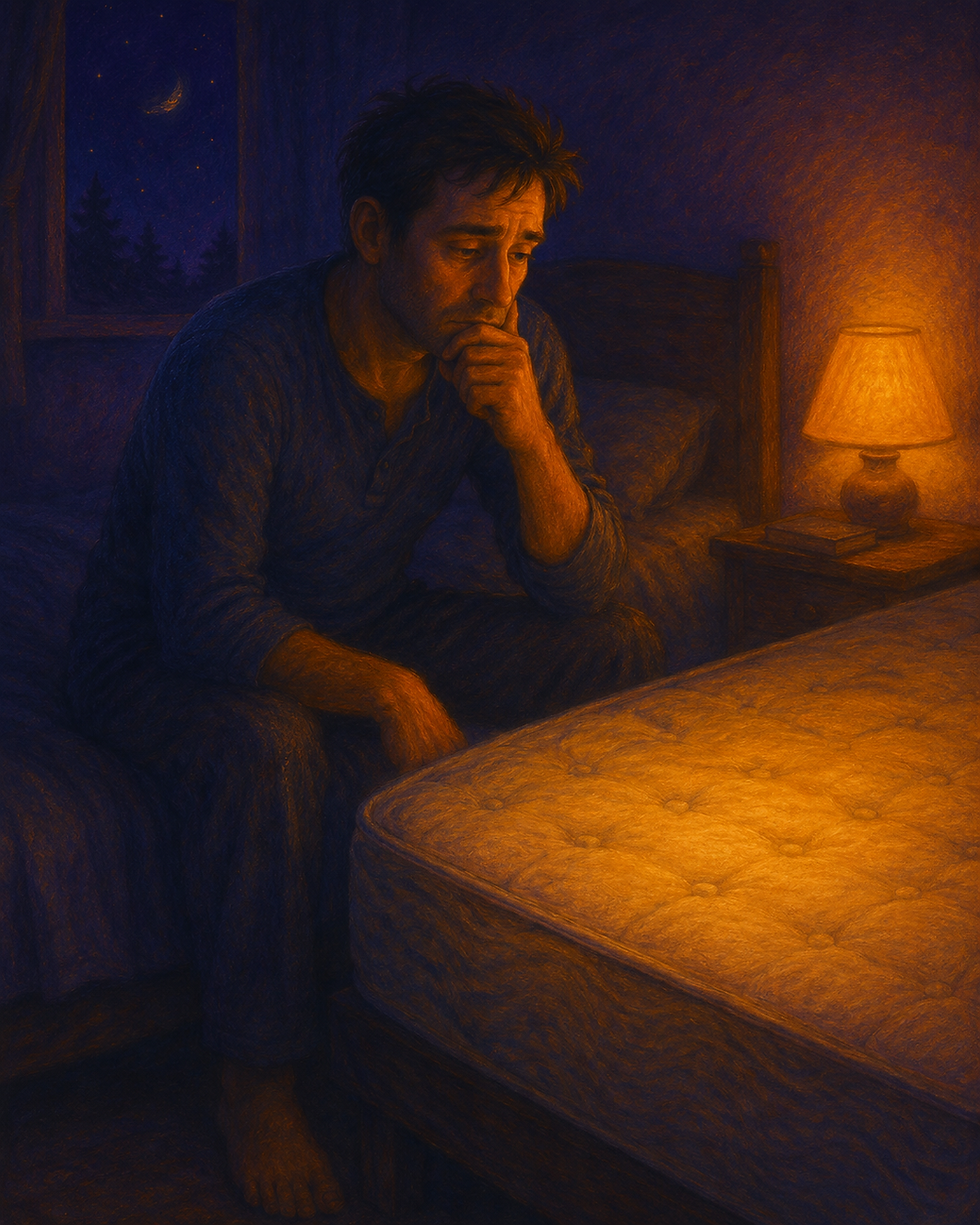
Nighttime anxiety has the amazing but unfortunate ability to make your tranquil bedroom feel like a very dreadful experience, with your mind fighting against you at every minute.
Every concern you have about tonight, tomorrow, your health, your quality of life and of course your sleep have flared up.
You start playing mental games to try to manage or subdue the anxiety as you know that sleep will not happen unless you feel peaceful and tranquil.
Fortunately what most people realize (including me for many years) is that the goal isn't to eliminate your anxiety before you sleep. This is not a helpful (or possible) goal. Those thoughts will most likely show up regardless. The real goal instead isn't to fight, wrestle, fix or research those thoughts but rather to simply acknowledge them.
How do I stop my anxiety at night?
It's counter intuitive but the answer is not by fighting, running or masking the anxiety (using any number of techniques or substances), as this creates pressure, monitoring and even more hyperarousal.
The answer is to voluntarily face it.
By voluntarily facing and in fact even embracing wakefulness we are facing our fears directly, which is the time tested best way to conquer or fears. It is what fears fear the most.
How can we do this in a practical way tonight?
Acknowledge what's happening (only briefly)
A simple but quick acknowledgment is all that's needed.
"Oh, there's that scary thought about my health again. Oh well."
It will most likely come up again, but we can just as effortlessly drop it.
Stop trying to 'calm down to make sleep happen'
Sleep is not something we can force to happen. Sleep is something that comes to us. At first the notion of something being outside of our control is scary but it becomes more relaxing over time.
Do something you'd genuinely do if sleep wasn't the goal
Usually we hear some common sleep hygiene advice along the lines of "Get out of bed and do something relaxing."
There's nothing inherently wrong with this but what people often get wrong is the intent behind it.
It's not helpful to do a relaxing or fun activity to make sleep happen. We can't make sleep happen. However if we were to do the activity entirely to make the experience more enjoyable, that's much more helpful. Again, we can't make sleep happen, but we can make wakefulness more enjoyable which helps invite sleep.
During the day: Give those thoughts some space
It's perfectly understandable if those thoughts that come up throughout the day become overwhelming. Sometimes what can be helpful is to do what I call a "Thought Download" and write them down on a piece of paper. We don't need to correct those thoughts necessarily but it's fine if we decide to do it here.
Sometimes writing out our thoughts can help soften their intensity and frequency.
Why do I feel anxiety at night?
To put it simply: because your brain has started treating nighttime wakefulness as a threat.
Your brain is a machine designed for your survival. When it decides something is dangerous it creates a lot of warning signals to get you to take action. This would be helpful in most situations, like if you were for example about to be attacked by a stranger on the street.
However our brain has improperly labeled being awake as a threat. We can't fight being awake in the same way that we can defend ourselves against a tangible threat like a dangerous stranger.
Some important clarifications we need to make:
Anxiety is NOT a death sentence for sleep
People often worry that if they feel anxious then that means that sleep is next to impossible. We can take comfort however that while anxious thoughts are distracting and not ideal, the main problem isn't the thoughts themselves but rather the engagement with them is.
Often it's not anxiety causing sleeplessness but rather sleeplessness fueling anxiety about sleep.
This means we aren't stuck in a "perfect feedback loop". As our sleep improves gradually the fears our minds throw at us lose a lot of their credibility
The aim is NOT to create a perfectly calm brain
Although this will happen organically in the background overtime, we are for the current moment looking to teach the brain that being awake at nighttime, although not ideal is not an emergency. Overtime our mind starts to quiet down more and more.
What is the best sleep remedy for anxiety?
The best long term remedy won't be found in a supplement stack or some "perfect" nighttime protocol.
The remedy is found in healing your relationship with nighttime wakefulness so we unlearn the fear we've developed.
All other solutions besides this direct one only reinforce the fear and anxiety for better or for worse.
A few notes on some common “remedies”:
THC (and other sleep aids) usually are a band aid fix
when used as a means to escape the fear of nighttime wakefulness. This is another way of saying that they find nighttime wakefulness so overwhelming.
Playing around with supplements comes with a psychological tax
when all's said and done with the researching and experimenting with different dosages and stacks, supplements usually aggravates our insomnia anxiety and are more of a detriment.
Any medication changes you're considering needs to be discussed with your doctor.
Medications carry the same psychological tax as supplements, but if you're considering doing away with them that is a discussion you would need to have with your doctor.
So what is the "best remedy"?
It's usually helpful to voluntarily face your fears of nighttime wakefulness. We can also practice Befriending Wakefulness to help make this a more pleasant process.
It might be best to take steps away from sleep efforts that only reinforce the idea that nighttime wakefulness should be avoided or is harmful. For example: Taking more time to research another magnesium sleep supplement.
It's usually helpful to measure progress by freedom, not by how many hours of sleep we get in the near term. The sleep we are looking for comes back to us slowly but we have to relearn that nighttime wakefulness is safe.
Sources:
Insomnia to Peace. (n.d.). Befriending Wakefulness | The Ultimate Root-Cause Fix for Insomnia! [Video]. YouTube.


Comments