Melatonin Stopped Working
- Mar 17
- 8 min read
Updated: Apr 19
Disclaimer: I am not a licensed medical or psychiatric professional. The content on this blog is for educational and informational purposes only and is not a substitute for professional medical, mental health, or sleep-related advice, diagnosis, or treatment.
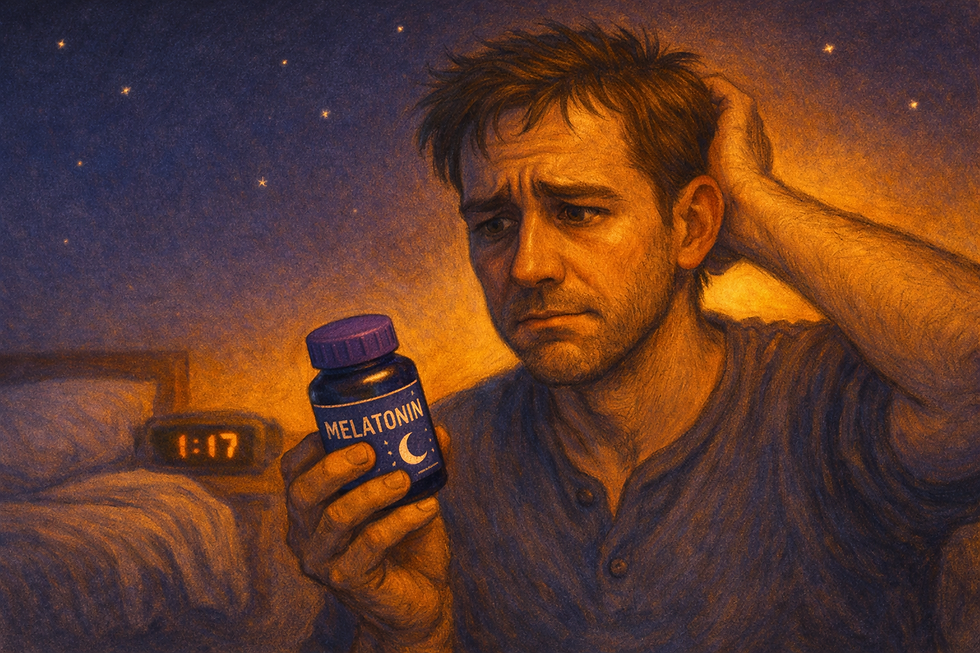
If melatonin stopped working, you’re probably asking yourself a pretty scary question: “What now?”
For many people, melatonin appears helpful at first. Maybe it made you feel a little drowsier. Maybe it gave you some hope. Maybe it became part of a safe bedtime routine. Then one night, it doesn’t seem to do much. Then another. And before long, you’re lying there wondering whether your body has changed, whether you need a higher dose, or whether you’ve somehow lost the ability to sleep naturally.
That spiral is incredibly common.
But in most cases, the biggest problem is not melatonin itself. The bigger problem is what starts happening around it.
When people begin struggling with sleep, they usually don’t start there. They start with some kind of normal sleep disruption. Stress. Travel. A rough stretch. A random bad night. A supplement change. A weird week. That part is ordinary. The trouble begins when the brain starts treating wakefulness as a threat.
Once that happens, sleep stops feeling passive and starts feeling like something you need to solve.
That is when melatonin can quietly turn from a casual supplement into something much heavier. It becomes the thing you rely on. The thing you measure. The thing you wait on. The thing you blame when you’re still awake at 1:17 a.m.
Much of the suffering comes from this shift: when melatonin stops working, and the focus shifts to controlling sleep, it can create more anxiety and pressure.
Because once melatonin feels responsible for your sleep, every bad night becomes a mystery to solve. Maybe the dose is wrong. Maybe the brand changed. Maybe you need a time-release version. Maybe you took it too early. Maybe too late. Maybe you built a tolerance. Maybe you need to stack it with something else.
Now sleep has become a project.
And the harder sleep becomes a project, the harder it tends to get.
Instead of asking, 'How do I make melatonin work again?' try asking, 'What has my relationship with sleep become?'
If bedtime has started feeling like a test, that matters.
If being awake feels dangerous, that matters.
If melatonin feels like a necessity rather than a preference, that matters.
None of that means you’re broken. It means your brain has learned to be on guard around sleep.
That’s actually good news, because a learned fear can be unlearned.
The goal is not to create the perfect chemical setup for sleep. The goal is to stop treating wakefulness like an emergency.
That might sound too simple, but it’s powerful.
If you’re awake at night, the move is not to go deeper into fixing mode. The move is to acknowledge that you’re awake and stop acting like something has gone terribly wrong. You do not have to force yourself to feel peaceful. You do not have to “master” your thoughts. You do not have to perform calmly.
You simply stop fighting reality for a moment.
Maybe you stay in bed and rest.
Maybe you watch something you enjoy.
Maybe you read.
Maybe you get up for a bit.
Maybe you do very little at all.
The important part is the spirit behind it. You’re no longer trying to make sleep happen. You’re becoming more open to being awake without turning it into a crisis.
That is very different from giving up.
It is also very different from trying harder.
A lot of people worry that if melatonin stops working, that must mean they’re in serious trouble. I don’t see it that way. Very often, it just reveals something important: melatonin was never the true source of sleep in the first place.
Sleep is a passive process. It’s something the body generates when there isn’t so much pressure, fear, and effort wrapped around it.
So no, melatonin “stopping working” does not mean you’ve lost sleep forever.
It does not mean your body forgot how.
It does not mean you need stronger supplements or a more complicated routine.
It usually means sleep has gotten tangled up with fear, monitoring, and effort.
And that can absolutely be untangled.
If you still take melatonin, that doesn't mean you’re doing anything wrong. This is not about moralizing supplements. It’s about seeing clearly what they can and cannot do. If you’re taking any supplement or medication and are thinking about changing it, that is something to discuss with your clinician.
But from an insomnia perspective, the way forward is not usually a more strategic approach. It’s less fear. Less chasing. Less bedtime pressure.
The people who sleep the best are generally not the people doing the most. They are the people who no longer feel so threatened by a rough night.
That’s the direction recovery goes in.
And once you start moving that way, the question shifts from “Why isn’t melatonin working?” to something much more helpful:
“Why have I been treating wakefulness like a problem I need to defeat?”
This is where real change begins.
Why am I not able to sleep even after taking melatonin?
A lot of people assume that if melatonin doesn’t lead to sleep, something must be seriously wrong.
But that usually isn’t what’s happening.
Melatonin is often treated like a switch. Take it, get sleepy, fall asleep. When that doesn’t happen, people panic. They start wondering whether they took the wrong dose, whether they need a stronger formula, or whether their body is somehow resisting it.
The deeper issue is often simpler than that.
If your nights have become full of pressure, sleep math, frustration, and fear, melatonin usually won’t override that. Once your brain starts treating wakefulness as a threat, bedtime becomes emotionally loaded. At that point, even something that once felt helpful can stop feeling reliable.
So if you’re not able to sleep even after taking melatonin, it doesn’t automatically mean your body is broken. It may mean you’re dealing with insomnia in the true sense of the word: not just wakefulness, but anxiety and struggle around wakefulness.
That’s an important distinction.
A bad night here and there is normal. Insomnia is what happens when we start fighting those bad nights so hard that sleep becomes a whole project.
That’s why the answer usually isn’t more effort.
It’s not more checking.
No more analyzing.
Not trying to make the perfect night happen.
It’s learning to stop treating wakefulness like an emergency.
If you’re awake after taking melatonin, try not to turn that into evidence that something terrible is happening. Acknowledge that you’re awake. Let the night be what it is. Rest. Read. Watch something. Stay with what feels natural, not with what feels like a strategy to force sleep.
That’s where the pressure starts to come down.
And that matters a lot more than most people realize.
If you’re thinking about changing the amount you take or stopping it altogether, that’s worth discussing with your clinician. But from an insomnia standpoint, the real work is usually not about making melatonin stronger. It’s about making wakefulness feel less threatening.
Can you develop a tolerance towards melatonin?
This is one of the first questions people ask when melatonin starts feeling less helpful.
And it makes sense. When something seems to work for a while and then feels unreliable, the mind immediately goes into detective mode. Maybe I built a tolerance. Maybe I need more. Maybe I need a different brand. Maybe I need something extended-release. Maybe I need to combine it with something else.
The problem is not just the question itself. The problem is what the question often pulls you into.
It pulls you deeper into the monitoring and control of sleep.
From an insomnia perspective, that usually keeps the struggle going.
I think a more helpful question is this: what role has melatonin started to play in your mind?
If it has become something you feel you need in order to sleep, that matters more than whether the exact issue is “tolerance.” If the idea of not taking it makes you anxious, or if every rough night sends you into more supplement research, the real problem is not just what’s in the bottle. The real problem is that sleep has become conditional in your mind.
Now you’re not just going to bed.
You’re trying to manage an outcome.
That tends to create more pressure, not less.
So, can you develop a tolerance? That’s how it may feel, but in insomnia recovery, look at the fear, dependence, and effort built around bedtime.
That’s what keeps people stuck.
The way forward is usually not endless troubleshooting. It’s stepping out of the cycle of trying to make sleep happen. That means becoming less invested in whether tonight goes perfectly, and more open to being awake if it shows up.
That is where confidence starts to come back.
And as always, if you’re taking melatonin regularly and are considering changing how you use it, bring your clinician into that conversation.
Is it possible for melatonin to stop working?
Yes, it can absolutely feel like melatonin stops working.
A lot of people experience exactly that. They take it, sleep seems a little easier for a while, and then suddenly it feels like they’re back where they started. Same bed. Same frustration. Same clock-watching. Same dread.
But here’s the part I think matters most:
When melatonin seems to stop working, that does not mean you are doomed. It usually means melatonin was never addressing the real issue underlying the insomnia.
The real issue is usually not a lack of effort or sleep hacks. It’s the fear that grows around wakefulness and lost sleep.
Once that fear is there, almost anything can become part of the struggle. Supplements. Routines. Meditation. Hot showers. The night becomes packed with tiny rituals that are all secretly trying to answer one question:
“How do I make sleep happen?”
That question is where a lot of insomnia lives.
Sleep is a passive process. The more pressure we put on it, the more slippery it can feel. So when melatonin stops seeming effective, many people assume they need to do more. In reality, that moment is often an invitation to do less.
Less forcing.
Less analyzing.
Less trying to secure the perfect night.
And more willingness to let wakefulness be there without treating it like a disaster.
That doesn’t mean liking it. It doesn’t mean pretending it feels good. It just means acknowledging reality instead of wrestling with it.
So yes, it is possible for melatonin to stop feeling helpful. But that is not the same thing as your body losing the ability to sleep. In many cases, it simply reveals that real recovery was never going to come from melatonin alone.
Why is my melatonin not working anymore?
When melatonin stops feeling effective, most people start troubleshooting immediately.
Maybe the timing is off.
Maybe the dose is too low.
Maybe the brand changed.
Maybe you need to take it earlier.
Maybe later.
Maybe your room isn’t dark enough.
Maybe you need a better routine.
I understand why people go there. When you’re tired and frustrated, it feels like you're being responsible for troubleshooting.
But with insomnia, troubleshooting often becomes a trap in itself.
The more you try to engineer sleep, the more bedtime can start to feel like a performance. Now you’re not just lying down. You’re monitoring. Comparing. Experimenting. Evaluating. Hoping this version of the routine finally works.
That creates a lot of pressure.
And pressure is a big part of why sleep feels so hard.
So why is your melatonin not working anymore?
Very often, it’s because the night has stopped being simple. Your brain has started seeing wakefulness as a threat, and melatonin has gotten pulled into that struggle. It becomes less of a neutral supplement and more of a safety behavior. Once that happens, every rough night feels more personal and more alarming.
That doesn’t mean melatonin caused the problem.
It means it can’t solve the problem.
The deeper issue is usually your relationship with wakefulness.
If being awake feels unacceptable, you’ll keep searching for the thing that guarantees sleep. But sleep doesn’t work well under that kind of pressure. It tends to return when you stop trying so hard to force it.
So instead of asking, “How do I get melatonin to work again?” it may be more helpful to ask, “How much fear and effort have I wrapped around sleep lately?”
That question leads somewhere useful.
Because once you begin lowering the threat around wakefulness, nights stop feeling so loaded. Sleep becomes less of a test. And from there, it can return to normal.
If you’re taking melatonin consistently and want to change how you’re using it, do that with clinical guidance. But insomnia recovery itself usually moves forward when your life stops revolving around whether tonight goes perfectly.



Comments